
The Hidden Problem With Comparing Super Funds
“What’s the best super fund?” is a question I hear all the time and see online.
Usually people move to assessing surface level performance which seems simple.
Investment A did better than Investment B over 1, 5 or 10 years.
But real performance comparisons are rarely that straightforward.
You need to consider risk, asset concentration, and how the underlying investments are valued.
Superannuation is a good example where most people try to compare (at the surface). Many people simply compare the Balanced or Growth options across different funds.
The challenge is that these categories are not consistent.
One growth fund might hold around 70% growth assets while another might hold more than 90%. These allocations can also shift within ranges during the year.
Some funds invest heavily in private infrastructure and private companies. Others mainly hold listed shares that trade every day on the market.
Recently a new client showed me the research they had done when selecting their super fund.
They were comparing one fund that held mostly listed shares with another that owned assets such as Sydney Airport and Southern Cross Station in Melbourne.
One fund was cheaper, the other appeared to have stronger long term performance.
The issue was how those assets were valued.
Listed shares trade every weekday and prices update constantly. Large infrastructure assets are typically valued only a few times each year.
Those valuations rely on internal policies.
Put yourself in in the super funds shoes valuing an airport in January 2020. Shortly after that a global pandemic shuts down international travel almost completely.
You would expect the value to fall quickly. But if the next formal valuation is not scheduled for several months the price might not immediately reflect that change.
Small differences in valuation policy can make returns appear smoother than they really are.
A well known example occurred in 2021.
Four major super funds held a large stake in ME Bank. One of those funds, Hostplus, valued the business about $100 million higher than the other three.
When performance numbers are reported it can look like one fund has delivered a stronger return even though they all owned part of the same asset.
The difference is simply how the asset was valued.
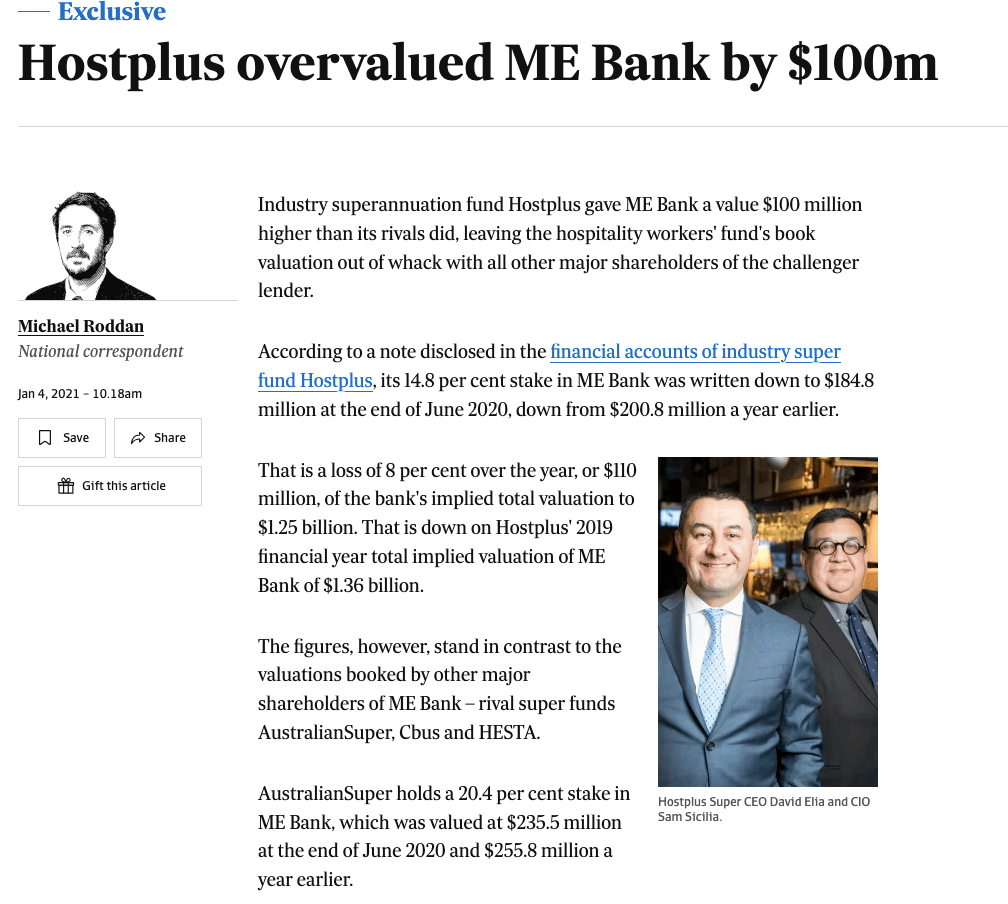
One example of many where the super industry is not as clear cut as you would assume.
Some super funds hold up to 45% of their portfolio in assets that require internal valuation rather than market pricing.
Instead of the market determining the price you are relying on the judgement of a small group of valuers.
The lack of regular pricing masks the up's and down's (volatility).
Comparing funds is a terrible place to start, it’s much better to start with your goals. In relation to super understanding when you would like to access the money and how big your pot could grow. That will help you rule in or out types of funds that make sense for you.
There are some funds that have tax advanages if you are high earner, there are some that make sense if your pot is below average. If someone is saying one fund is right for everyone then they don’t understand the system.
Then you can work out your investment strategy. You will hear words like conservative, balanced, growth. These are terms that don’t always mean the same thing between funds, what’s the most important decision is your asset allocation - how much do you add to shares, property, fixed interest, cash or alternative assets.
Once you know the answers to the first 2 steps then you can move onto comparing funds and the underlying investment options, and relevant fees. However by this point you filtered out a majority of the market.
For those that don’t want to DIY their retirement life savings there is always the option of getting some personal financial advice.
'Want to know more?
1) You can click here to book a free 15-minute free clarity call with Sam Woodhouse to discuss how this may relate to you.
2) Join our Your Money Simplified email list to start taking control of your money today. And when you subscribe, I'll give you a PDF called My 3-Step Process for Building Your Road Map to Financial Freedom.
The information contained in this article is general information only. It is not intended to be a recommendation, offer, advice or invitation to purchase, sell or otherwise deal in securities or other investments. Before making any decision in respect to a financial product, you should seek advice from an appropriately qualified professional. We believe that the information contained in this document is accurate. However, we are not specifically licensed to provide tax or legal advice and any information that may relate to you should be confirmed with your tax or legal adviser.