
Should you actually be putting money aside for your kids?

I commonly see well meaning parents make the mistake of ineffectively putting money away for their kids a decade or more in advance.
They set up a bank account for each kid and give it a name like “Frank's future”.
It makes sense on the surface. You have a clear goal, you are putting money aside and you can see the balance building over time.
The problem is that the way you are doing it can sometimes be working against the bigger financial picture.
One issue is that they are usually moving money into a bank account earning 4 to 5% before tax, rather than leaving the money against the home loan or in the offset, where it could be saving them 6 to 6.5% in interest after tax.
If you have a $500,000 home loan and $20,000 sitting in the offset, that $20,000 is effectively saving you around $1,200 a year in interest if your loan rate is 6%.
Move that money into a savings account earning 4.5% and you might earn $900 before tax.
You have taken money that was saving you 6% on your home loan and moved it somewhere that is earning 4.5%, before tax.
That doesn't mean a savings account is always the wrong place for the money, but it is worth looking at what the money is actually doing rather than just giving it a name and assuming you are doing the right thing.
The other issue is the value of money over time.
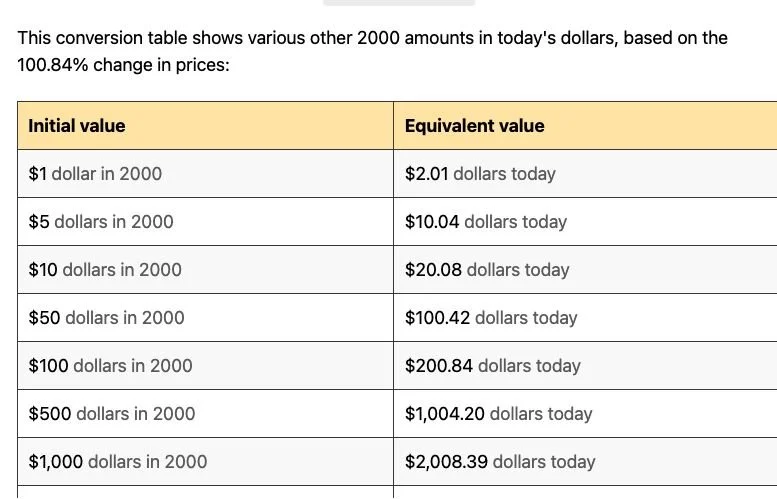
If the goal is 18 years away, inflation means the $100 you put away today is not going to have the same buying power when your child needs it.
At 3% inflation, you would need around $170 in 18 years to have the same purchasing power as $100 today
So when you are thinking about putting money away for your kids, I think it is worth looking beyond the account balance and thinking about what you actually want the money to achieve.
Maybe you want to :
Help them with university.
Help them buy their first home.
to give them some money to start a business.
Maybe they will need help with something completely different.
The problem is that you don't know yet.
Your two year old might have a very different life at 18 or 25 than you expect today.
This is why sometimes the better approach is to put your own oxygen mask on first.
If you have a large mortgage, limited investments and not much financial flexibility, putting $100 a month into an account for your child might make you feel like you are doing something useful, but it may not be the most effective way of improving your family's financial position.
Instead, you could focus on building your own wealth.
Pay down the mortgage.
Build your investments.
Create some financial flexibility.
Put yourself in a position where you have options.
Then when your kids actually need the money, you are in a position to provide it.
The important part is that you have created the financial capacity to make that decision later.
I think this is an important distinction because parents can sometimes become focused on putting money in their child's name, when the real goal is simply to be in a position to help their child financially in the future.
Those are two very different things.
There is nothing wrong with setting up a bank account for your kids, particularly if the goal is to teach them about saving and managing money.
But if you are talking about building meaningful wealth over 10, 15 or 20 years, I think it is worth looking at the bigger picture and consider investing (to at least keep the purchasing power of this money over the long term).
You don't necessarily need a separate account called "Frank's future" to create a better financial future for Frank.
Sometimes the best thing you can do for your kids is to build your own financial position first, if you are not a “serious” investor. yourself yet then this maybe a costly distraction.
The stronger your financial position is, the more options you will have when they actually need you.
And that is ultimately what you are trying to create. Not just a bigger bank balance but more options for your family in the future.
Want to know more?
1) You can click here to book a free 15-minute free clarity call with Sam Woodhouse to discuss how this may relate to you.
2) Join our Your Money Simplified email list to start taking control of your money today. And when you subscribe, I'll give you a PDF called My 3-Step Process for Building Your Road Map to Financial Freedom.
The information contained in this article is general information only. It is not intended to be a recommendation, offer, advice or invitation to purchase, sell or otherwise deal in securities or other investments. Before making any decision in respect to a financial product, you should seek advice from an appropriately qualified professional. We believe that the information contained in this document is accurate. However, we are not specifically licensed to provide tax or legal advice and any information that may relate to you should be confirmed with your tax or legal adviser.